Situated on the shores of Lake Ohrid, the town of Pogradec is a city with an ancient history and numerous cultural, geological and natural values. Based on archaeological findings (ceramics) an Illyrian settlement existed on the hill in north-west of the city in the 5th century BC and was then fortified in the 4th century BC. The Pogradec people were first called Illyrians (the ancient tribe of Desaret and maybe Enklelej), then Arbër, and finally Albanians. The fortified settlement has had a 1400-year-existence which ended in 7th-8th century with the Slavic invasion and then after the Bulgarian occupation in 9th-12th century the life within the fortification walls was abandoned and a new city was formed in the field area under the castle hill. The new city was named "Podga Grada" (Pogradec) meaning under the city. The city of Pogradec and its historic-cultural region are located in a natural setting of exceptional beauty, while its historical centre represents an example of 19th-20th century Albanian vernacular architecture. Even though with a small area, its old typical streets and houses bear the values of Albanian vernacular architecture and urban setting, revealing the particular atmosphere of this period. The existence in this region of the ruins of the paleochristian church of Lin together with its exceptionally beautiful floor mosaics reveals the presence of Christianity as well as the importance of this area in the period. Traces of the Roman road Via Egnatia found in the region of Pogradec near the shores of Lake Ohrid are evidence of this important passage route in this part of Albania.
Justification of Outstanding Universal Value

The paleochristian church of Lin is one of the most important monuments of 6th century in Albania which conserves nearly untouched the overall plan and the floor mosaics. The periodic conservative works, have contributed in the conservation of the original wall contours and of about 120 m2 floor mosaics. Together with the baptistery of Butrint (World Heritage) these are the two unique central plan churches conserved in Albania. These two churches are known also for the outstanding artistic values of the floor mosaics.
Criteria:
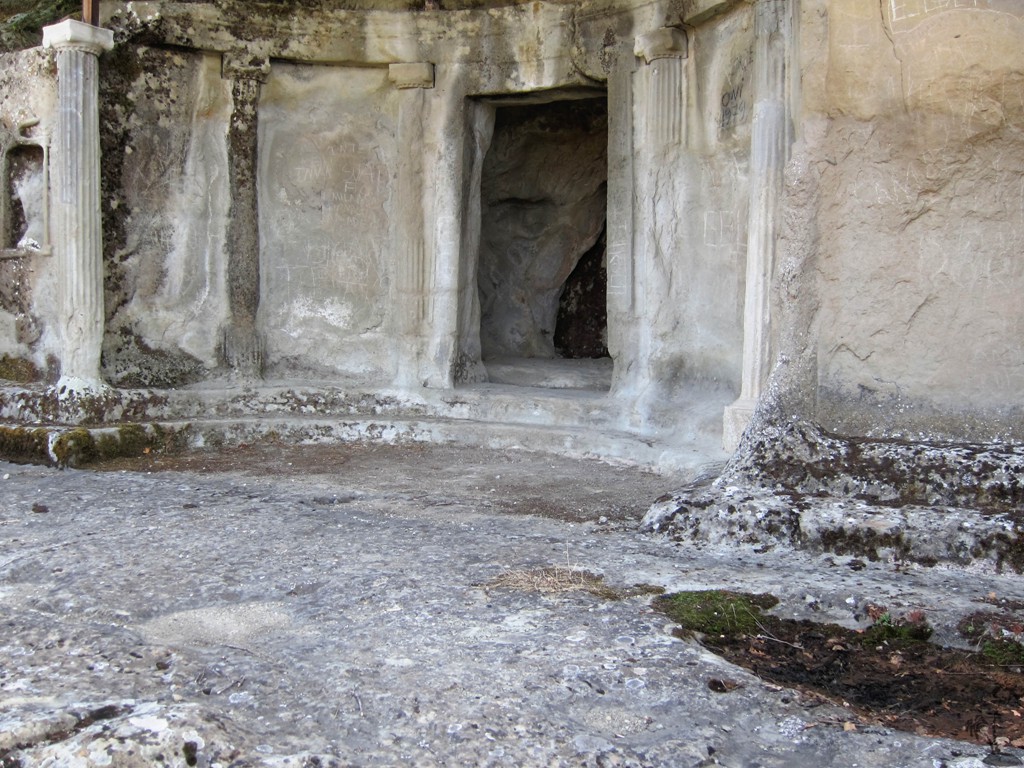
(iii) The archaeological findings in the castle area of the city of Pogradec as well as the presence of the monumental tombs of Lower Selca in the region are evidence of the ancient Illyrian civilization. The actual town planning and housing in the historical centre of Pogradec are evidence of the 19th - 20th century town life.
(iv) From the architectural point of view the 6th century triconch church of Lin village is a rare example of central plan churches in Albania while its well preserved, highly colored floor mosaics bear outstanding artistic value.
(vii) Lake Ohrid lays in southwest of Balkan, shared between Albania and FYROM. It is the oldest lake in Europe and one of the oldest in the world. His origin is tectonic, and it's suggested to be created 4-10 million years ago. It is situated on 41 degree northern latitude and 20 - 21 degrees eastern longitude, and its altitude is 695 meters above sea level. It covers an area of 358.2 square kilometers, two thirds of which belong to FYROM, and one thirds to Albania. The shoreline is 87.5 kilometers long - the maximum length being 30.8 kilometers, and its maximum width is 14.8 kilometers. The average depth is 164 meters, and the maximum depth 289 meters. On the Albanian side The Lake is surrounded by mountain ranges of Mokra 1589 m. and Jablanica 1945 m The surrounding mountains are karstic. There are more than 40 rivers and streams that flow in to the lake Ohrid. The bedrock structure of the watershed area includes rock masses of various types, compositions and age, going all back to the Paleozoic, Mesozoic and Cenozoic eras. In the Albanian Side of Lake Ohrid there are several nature monuments such as caves, springs, special geological features etc.

(ix) Lake Ohrid ecosystem is considered as a nature center for conservation of biodiversity and landscape. It is a habitat for conservation of several endemic species of fauna and flora. Because of its very old age, geographic position, surroundings from mountains and hills, and its condition still oligotrophic, Ohrid lake continues to have a great collection of plants and animals which are unique in the world. It includes numerous of relict forms;"alive fossils" and a lot of other endemic species that are found only in this lake. The Lake Ohrid fish fauna include 17 native species, of which 10 are endemic (two of which belongs to Salmonide family). Ten from the fish species have a commercial value. But also a lot of snails (85%), worms, and sponges are endemic species.
Littoral zone is characterized from considerable communities of the plant and animal species. The red belts at this part of the lake have a big ecological importance as biotopes for a lot of other organisms, places for fish reproduction, and bird nesting place. Related to bird nesting over 60,000 birds have been observed in lake Ohrid.
Based on the biological and natural values the Albanian part of the lake Ohrid has been proclaimed as Protected Areas under the category V of IUCN.
Satements of authenticity and/or integrity
Due to the great cultural and historic values, the city area which dates back to the 19th - 20th century is in process to be proclaimed Historical Center. The original elements in the façade and interiors are evident but needs an overall restoration.

Regarding to the state of conservation of the paleochristian church of Lin, the periodic conservation works, have contributed in the conservation of the original wall contours and the floor mosaics.
Comparison with other similar properties
The triconch church of the village of Lin presents similarities with the baptistery of Butrint regarding the construction typology. Both these churches are the only central plan churches conserved in Albania. They are known also for the outstanding artistic values of the floor mosaics.
From the typological point of view the triconch church in the village of Lin can be compared with the tetraconch church in the city of Ohrid. Similarities can be seen in the location of the baptistery in the southern area. Given the similarity of their plans, their location, and the stylistic similarity of the floor mosaics as well as the mosaics schemes, it can be assumed that may have been constructed by the same workshops for the construction of floor mosaics operating in the area of Lake Ohrid.
 Butrint is an archaeological site that provides valuable evidence of ancient and medieval civilizations on the territory of modern Albania.
 Roman occupation prompted the development of the city and, during the Christian era, it became the seat of a bishopric. Many religious structures were built by the Christians. From the time the Slavs came to the Balkans (7th century) until the founding of the Epirus despotate (after the taking of Constantinople by the Crusades in 1204), the city underwent great trials.
 The city’s last era of prosperity was under Byzantine administration (Epirus). After a short period of occupation by the Venetians (late 14th century), the city under Ottoman administration was threatened by the marshes that formed around the lake, and was abandoned by the population.